
Technical Analysis crash course: Understanding the RSI
In our previous discussion, we delved into the MACD indicator, a favorite among traders. Today, let’s shift gears and explore another heavyweight in the trading arena: the Relative Strength Index, or RSI.
The RSI is a trend indicator that essentially measures the momentum of price movements by comparing the magnitude of recent gains to recent losses. It outputs a value between 0 and 100. Here’s a quick breakdown:
An RSI reading above 50 suggests bullish momentum.
Conversely, below 50 indicates bearish momentum.
Sounds simple, right? Well, there’s a bit more to it. The RSI also helps identify potential reversals in the market:
Readings above 70 typically signal that a stock might be overbought.
Readings below 30 suggest a stock could be oversold.
When the RSI tops 70, it could mean that the market enthusiasm is waning as early buyers start to cash out. Meanwhile, a dip below 30 often signals that a downtrend might be reaching its end, attracting buyers keen on snagging a bargain.
The simplest way to leverage the RSI? Consider buying when the RSI indicates a stock is oversold and think about selling when it’s overbought.
However, like the MACD, RSI signals are not foolproof. Let’s look at some real-world applications:
Example 1: Shoprite (SHP)
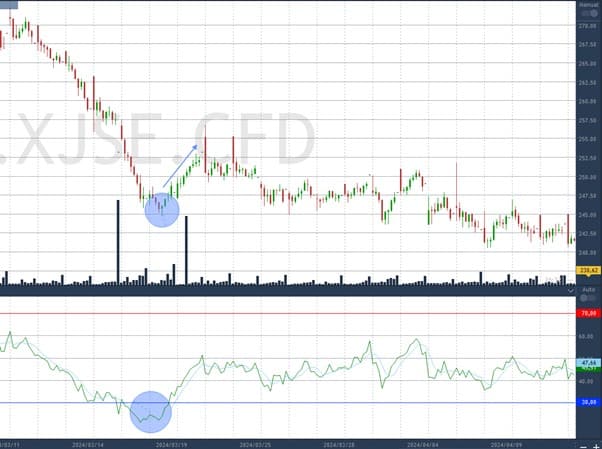
The RSI flagged an oversold condition for SHP, and the stock price soon rebounded. Although the price dipped again later, this presented a prime opportunity for short-term traders to make a profitable move.
Example 2: Standard Bank (SBK) RSI

Here, the RSI signaled an overbought condition. Although SBK’s price hovered for a while, it eventually declined, rewarding those who were patient with their short positions.
That’s the RSI in a nutshell—simple yet powerful.
Interested in trying your hand at RSI trading? Consider opening an account with Rand Swiss, South Africa’s top-rated broker four times over. To get started, just complete our mandate, send us your FICA documents, and once your account is set up—typically within a day—you’ll need to deposit a minimum of R25,000. Our brokers are ready to help you get up and running and can assist with your initial trades.
Not a subscriber to Money Morning?
You can get free daily recommendations like these with Money Morning eletter. Just sign up here.


